The New Marketing Operating Model: 4 Shifts from Marketing Futures
You know this one already. Speed-to-market expectations are compressed. Budgets aren't growing. AI is rewiring workflows faster than most teams can keep up, and reactivity isn't good enough anymore. You're accountable for the whole customer journey, and you can see almost none of it.
So how do you actually operate?
That was the question behind Marketing Futures. We brought together leaders across brand, agency and platform to talk honestly about what's working inside marketing teams right now.
The short answer: there is no single new marketing operating model. But the teams furthest ahead are making four shifts: from campaigns to continuous, from communications to owning the whole customer experience, from owning capability to assembling it fast, and from annual audits to always-on visibility. AI runs through all four.
Marketing has become continuous. The model is still built for campaigns.
This was the spine of the night. Marketing used to run in bursts: a big campaign, a launch, a moment. That world is gone. Customers now move continuously, across more channels than any team can staff, and the work never stops to wait for the next quarter. AI has only poured fuel on it, making it possible to produce more of everything, faster.
But the structure underneath most teams didn't keep pace. It fragmented. As the channels multiplied, organisations decentralised, each team taking its own slice with its own tools, its own data, its own targets. The result is a familiar stalemate: every channel performing beautifully against its own number, and none of them helping each other, because no one ever aligned the numbers in the first place. The customer, meanwhile, ignores every internal boundary you drew.
Andrew Trimboli, who has spent a decade building content and CX systems across Asia, was blunt about how common this still is. In most organisations, he argued, content and customer experience are still treated as an afterthought, while the brands that win treat them as the main event.
"The customer has evolved way faster than marketers have. That's the problem." — Andrew Trimboli, Founder, Faro
The fix, Britt Fox argued, isn't another tool to bolt on. It's a change in how teams are measured. Move from siloed ownership to shared outcomes, so channels are rewarded for helping each other hit the number rather than only their own. And make finding the gaps an always-on activity, not a once-a-year audit, so the picture stays current as the customer moves.

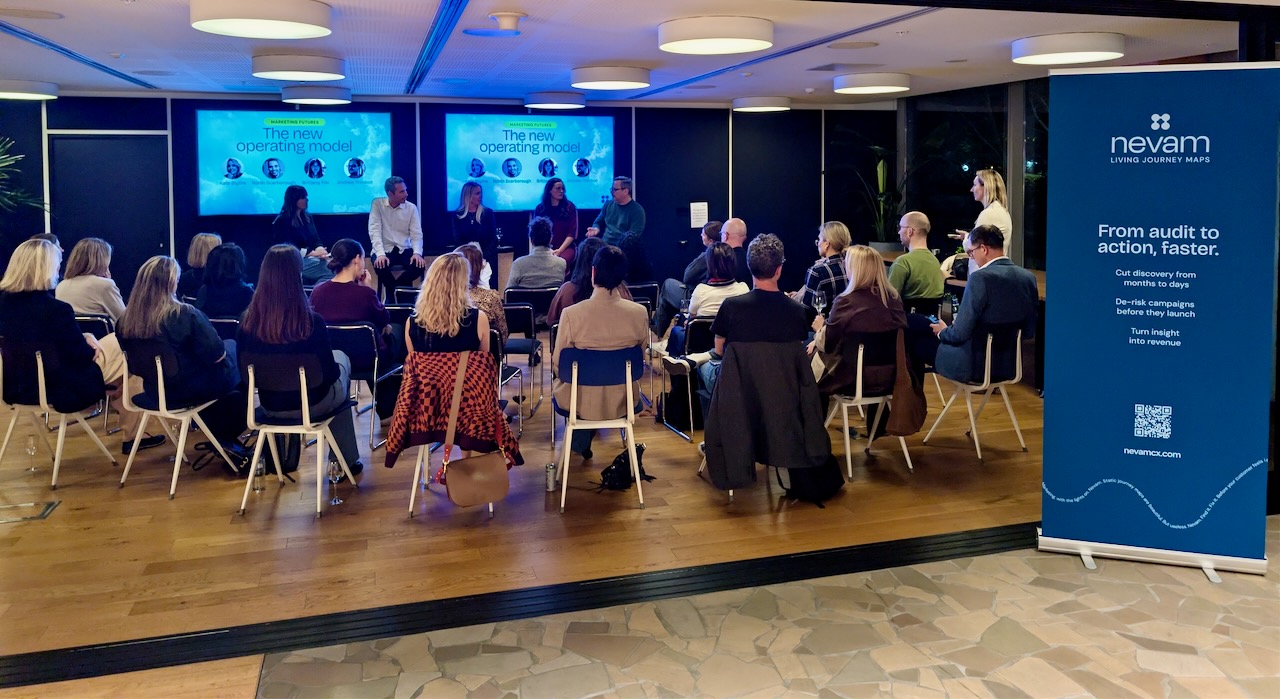
Nevam Marketing Futures Panel: Claire Waring, Robin Scarborough, Kate Blythe, Britt Fox and Andrew Trimboli.
The remit has expanded from communications to the whole customer experience.
Marketing's job is no longer to make the campaign. It's to own the experience, end to end. The clearest signal of where the role is heading came from Kate Blythe, who has just moved from CMO to Chief Customer Officer at Greencross. The point isn't the title. It's what the structure forces: when one person is accountable for both sales and the customer, the silos start to dissolve, because no one can hide behind their own channel metric anymore.
"The better title is chief customer, because you're thinking about your customer at every single interaction of their journey." — Kate Blythe, Chief Customer Officer, Greencross
Very few companies are built this way yet, which is exactly why it reads as a signal of where the CMO role needs to head. But Kate was clear the title alone changes nothing. The harder shift is speed: getting an organisation used to moving channel by channel to operate as one fast-moving whole. Most teams, as she put it, are still trying to turn a Titanic into a speedboat.
Advantage comes from how fast you can assemble capability, not how much you own.
For years the debate was in-house versus agency. Robin Scarborough's argument is that this is the wrong question. A marketing team's remit has grown broader than any single team, or any single agency, can cover, and budgets haven't grown with it. So the advantage no longer comes from the size of the team you own. It comes from how fast a marketing team can put the right capability on a problem and move.
In Robin's data, the most interesting, highest-value work increasingly comes from small, senior teams that assemble quickly, shortcut the layers, and bring outside challenge, rather than from long retainers and big standing structures. The lesson for brands: keep close the work that benefits from being near the customer, and assemble specialist capability when you need it. But assembling quickly only matters if it leads somewhere, which is where his sharpest point landed.
"We've been seduced by speed of output. The thing we should really focus on is speed of decision-making." — Robin Scarborough, Co-founder, Studiospace
Andrew Trimboli made the same point from the craft side, with a caution worth holding onto. Speed up the prototypes, the artefacts, the internal scaffolding, but protect the thinking, the empathy and the judgement, because those are the things the tools can't do for you. Moving fast is the goal. Mistaking faster output for faster progress is the trap.
Annual audits are over. Visibility has to be always-on.
Underneath all of it sits the thing that makes the rest possible, or impossible. Marketing accountability has outpaced our ability to see what's actually happening. So teams stay stuck on an audit treadmill, reviewing the customer journey once a year, or scrambling after a bad score, when finding the gaps should never stop.
It's also why so many companies get the journey wrong in the first place. As Andrew Trimboli put it, too many haven't actually mapped the customer's journey at all, they've built one they're pushing the customer through and called it a strategy. You can't see the real journey, so you default to forcing your own.
"It's a journey you're trying to force your customer down." — Andrew Trimboli, Founder, Faro
A continuous model can't run on a once-a-year snapshot. The move is to make visibility always-on, so you see the whole journey as it moves rather than reconstructing it after the fact. Marketers don't need more data. They need daylight. And it's what makes the other themes work in practice: you can't restructure, assemble capability or decide faster toward an experience you can't see.
"AI doesn't make marketing simpler. It makes the complexity manageable, but only if you use it to create visibility, not just to generate more." — Britt Fox, Founder, Nevam
AI talent: Grow the capability. Don't buy it.
AI ran under every theme of the night, but the sharpest thing said about it was about people, not tools. There are no AI experts to hire, because everyone is learning at once. So you grow the capability instead of buying it: keep your best people, give them the remit and the tools, and let them teach the rest. Canva came up as the example, lifting productivity by turning its existing experts into people who direct AI, rather than cutting headcount.
Kate Blythe's framing was that this isn't a threat to jobs, it's a remit change. The customer care team becomes a concierge team. The specialist becomes the person who trains and directs the models. The job is to bring the whole organisation along, not to stand up an AI team in one corner and call it transformation.
Andrew Trimboli's advice was to find the right people and back them.
"You need the agitators, the squeaky wheel, the ones who ask the hard questions and hold high standards. They're the ones that make progress." — Andrew Trimboli, Founder, Faro
And a caution to hold next to the optimism. AI will speed up almost anything you point it at, but it can't replace thinking, empathy or judgement, and it will agree with everything you say unless you make it argue. Used well, it sharpens expertise. Used blindly, it just helps you produce more of what you couldn't see clearly in the first place.
What you can do tomorrow
The themes are big. The first steps don't have to be. A few things any team can start without waiting for a twelve-month transformation and three steering committees:
1. Time your insight-to-action. How long does it take to act on something once you've seen it? If the honest answer is months, unless it's on fire, the structure is the problem, not your team. Britt Fox called this the most important operational metric most teams don't track.
2. Take the audit off the annual calendar. Swap one yearly review for a lightweight, always-on check on where the journey is breaking. Visibility you refresh once a year isn't visibility.
3. Tie every piece of content back to something real. A metric, a business challenge, a customer need. As Andrew Trimboli put it, that's how you produce trust instead of noise. Simple to say, hard to hold to.
4. Use AI to see, not just to make. Point it at the data and reports you already have and ask what you're missing, before you ask it to produce anything new.
5. Don't wait to be trained. Go and learn it. Kate Blythe's own edge has come from staying curious and moving early, watching where things are heading and getting there first. The art director who becomes an AI art director doesn't get left behind. Reinvent the role before someone reinvents it for you.
What's next
No single one of these themes is the answer on its own. They hold each other up. Restructuring around the customer is what gives one person the mandate to act. Assembling capability is what lets you move when you decide to. Getting faster without losing the craft is what keeps the work worth shipping. And continuous visibility is what tells you where to point all of it.
If there was one thread under the whole night, it was speed of decision-making over speed of output. Foresight, not fire drills. Every theme on that stage came back to the same move: getting marketers from doing more to deciding better, from hoping it works to knowing it will. That's the model worth building toward.
Make better journey decisions with live customer data.
See how Nevam reveals the journeys behind customer behaviour.