Discover how digital twin technology is beginning to reshape marketing and customer experience. By replicating the customer journey digitally, teams can simulate real scenarios, identify friction earlier, and move from reactive analytics to proactive optimisation.



When marketing teams ask, “What do we fix first?”, it’s usually because something has already gone wrong.
The journey looks fine on the surface.
Campaigns are live. Traffic is flowing.
But customers are stalling.
Support tickets are rising.
Something isn’t landing.
Now the question becomes: what do we prioritise?
Everything feels urgent and that’s when prioritisation collapses into reaction. Fix the loudest issue, patch the most visible problem and push out a new feature to signal progress.
But firefighting is not prioritisation, it is a temporary release.
If your organization is constantly operating in “everything is on fire” mode, the issue isn’t just what to fix first. It’s how decisions are being made in the first place.
Let’s separate the two.
Part One: When everything really is on fire
There are moments when triage is necessary.
Customers are stalling, conversion is uneven and teams are escalating different problems at the same time. Every department believes their issue is the most urgent.
The instinct is to start fixing.
The smarter move is to slow down - just enough to see clearly.
When we work with enterprise teams, we begin by mapping the customer experience end-to-end and surfacing every friction point in one place.
In one recent audit, that meant identifying over 40 separate friction points across the journey. Some were obvious, many were not.
Once friction is visible, it must be sized.
This is where most organizations struggle.
They see the problem, but they don’t have a shared way to evaluate it.
So we apply a simple matrix: value versus effort.
First, analytics quantifies what each friction point is actually costing the business.
- Where is conversion being suppressed — and what is that worth?
- Which issues are eroding revenue right now?
- Where is avoidable churn or operational cost quietly accumulating?
Then delivery teams scope the effort.
- What will it actually take to resolve this?
- Is it a copy change, a structural rebuild, a systems dependency?
- Is this a small, medium, large or XL sized effort?
Only when both sides carry a number does prioritization become rational. Value quantified. Effort sized. The work with the highest return and lowest cost moves first.
That's what removes opinion from the room and it prevents six months being spent on a complex rebuild while a straightforward optimization quietly leaks performance.
That addresses the immediate fire, but it doesn’t solve the deeper pattern.
Because if everything is always on fire, the issue isn’t prioritization.
Part Two: Why everything is always on fire
In most enterprises, teams operate at a single speed: urgency.
Bugs dominate sprints, new features override optimization and campaign deadlines displace structural improvements.
The result is predictable. Work compounds unevenly, technical debt accumulates and friction is deferred instead of resolved. Small inefficiencies evolve into larger breakdowns.
The business feels perpetually reactive because it is structured to be reactive.
That structure has a name: single-speed execution. And the fix isn't better crisis management. It's deliberately building in more than one speed.
- New initiatives: the strategic work that creates future growth.
- Optimization: improving what already exists, refining prior launches, and reducing drag before it compounds
- Bugs and breakdowns: the work that keeps the system functional.
If all capacity is allocated to new features, debt accumulates.
If all capacity is allocated to bugs, momentum stalls.
If optimization is ignored, friction compounds until it becomes a crisis.
Balancing these three speeds changes behaviour.
It ensures that every sprint is not swallowed by whatever is most visible that week. It creates space to improve the system while still delivering new capability. And it prevents optimization work from being perpetually deferred until it becomes urgent.
This does mean new initiatives move at a steadier pace. But the trade-off is powerful: the organization shifts from reactive firefighting to proactive improvement.
Over time, fewer issues escalate. Fewer journeys unravel, fewer emergency meetings are required.Because optimization is no longer something you do when things break.
It becomes part of how you operate.
That is the real goal, not simply answering the question, “What do we fix first?”
But building a system where the question doesn’t need to be asked every quarter.
Where most prioritization breaks down
The framework only works if the insight travels with the work.
That's the part most teams get wrong. Not the prioritization itself, but the handoff. Marketing identifies friction, analytics quantifies the opportunity, development scopes the effort. But without a shared framework, intent gets diluted as work moves across teams.
This is why our insight feature in Nevam was built the way it was. Every friction point identified through the process becomes a structured record that moves with the work:
- A clear problem statement
- A defined recommendation
- A value estimate tied to KPIs
- An effort estimate
- A measurable outcome
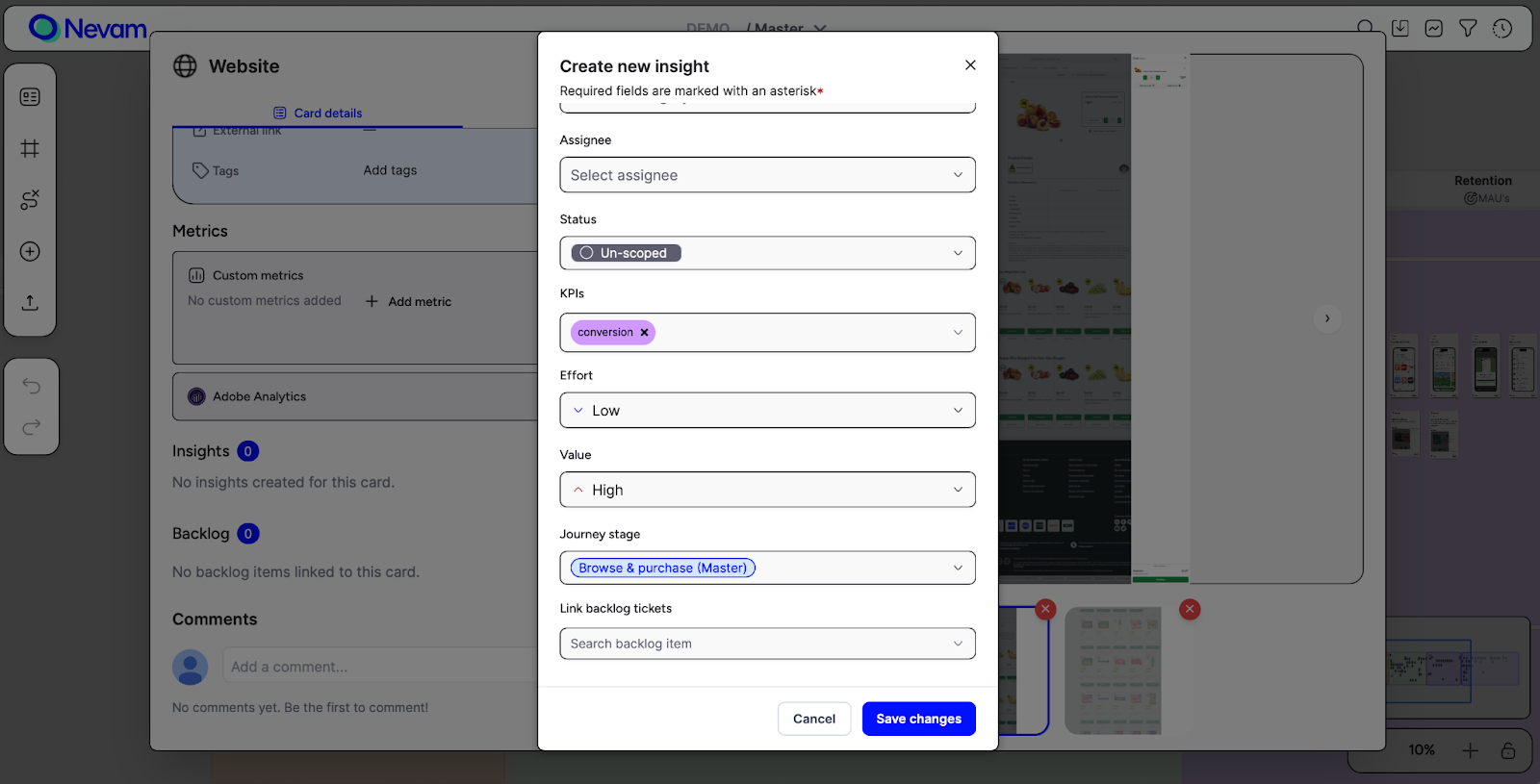
This structure forces clarity before execution. It allows non-technical leaders to articulate why something matters, and it gives technical teams the context they need to scope accurately.
Prioritization becomes visible, shared and defensible - not reactive.
Final thoughts
Asking ‘What do we fix first?’ is necessary in moments of stress.
But the more strategic question is this:
What operating rhythm ensures we are not constantly putting out fires?
Firefighting feels productive in the short term.
Structured optimization compounds in the long term.
The teams that institutionalize prioritization — linking friction to value, effort and measurable outcomes — eventually find themselves asking a different question.
Not “What’s on fire?”
But “What’s next?”
Latest insights from our articles
Explore a collection of curated articles that keep you engaged and informed about the latest trends in social media marketing.

What is a digital twin for marketing?

We are beyond proud. Brittany Fox wins the Innovator Award at Women Leading Tech 2026.
This Friday night, our founder Brittany Fox took home the Innovator Award at the Women Leading Tech Awards by B&T, sponsored by Atlassian.
Not quite ready to engage but want to stalk us just a little?
Be part of the product community!
What if there was a place where marketers, leaders, agencies and digital teams could talk about the real challenges? Not another Slack group filled with tool promos. Not a webinar where you’re talked at for an hour. But a community built around you.
.png)
Connect with us